Some founders grow into entrepreneurship slowly. Others show early signs that they’re wired to tinker, test, and push boundaries.
For REaKTOR founder Joseph Wright, that instinct showed up early, long before he stepped into a university lab or began evaluating NASA-patented technologies for commercialization.
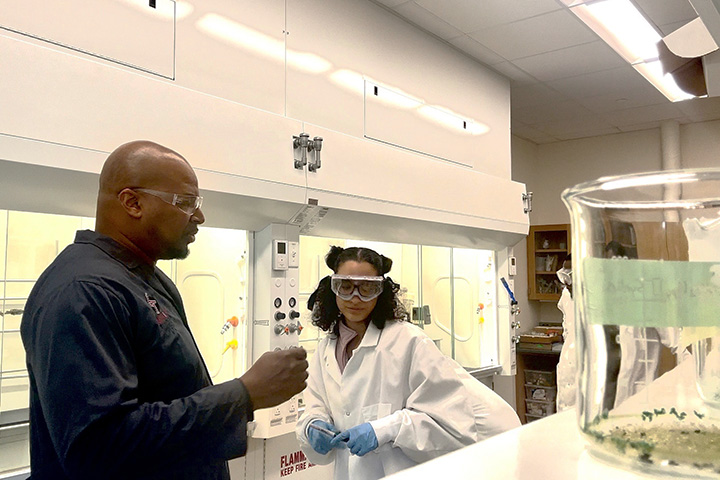
Joseph’s path began with a deep curiosity about how complex systems work: environments, machines, chemical processes, and the rules that govern how materials break down, transform, and interact. What started as simple experiments grew into hands-on engineering challenges, including the construction of a fully operational pyrolysis reactor, a project that showed both his technical versatility and his fascination with carbon systems.
Today, that early spark has evolved into a research-driven pursuit to solve some of the most pressing environmental and infrastructure challenges facing communities.
Joseph’s academic and research experience spans environmental engineering, mechanical engineering, and biomedical engineering, giving him a rare lens.
While many engineers specialize deeply in one domain, Joseph leans into an intersection where chemistry, materials science, computational modeling, and systems design all meet.
Across Joseph’s projects, a unifying theme emerged: carbon. From water-quality challenges to new material formulations, his work revolves around understanding carbon’s capabilities and rethinking its potential applications: how we produce carbon, how we use carbon, and how we might re-engineer it to solve real-world problems.
His expertise in carbon systems and his environmental engineering mindset have also been recognized across the water sector.
Joseph was recently profiled in The Conduit, the official publication of the Virginia Water Environment Association, for his innovative work in water treatment research and his journey through VWEA’s InFLOW program. The feature highlights how early experimentation, hands-on research, and targeted mentorship shaped his understanding of water-quality challenges and carbon’s role in solving them.
That focus is now driving his transition from researcher to founder.
Joseph is currently evaluating a NASA-patented carbon technology with potential applications in multiple industries. While still in the research phase, the system shows early promise for:
-
improving water treatment processes,
-
creating more efficient carbon-based materials,
-
strengthening environmental resilience, and
-
addressing infrastructure challenges in resource-constrained communities.
NASA’s Technology Transfer Program is designed precisely for innovators like Joseph; researchers with the technical depth and entrepreneurial drive to bring federal intellectual property into the private sector. As Joseph explores the commercial viability of this technology, he is also mapping its potential fit for industries that need stronger, cleaner, more adaptive carbon solutions.
It’s a classic REaKTOR moment: a founder with deep expertise working to translate breakthrough science into a company with real-world impact.
REaKTOR exists to help founders like Joseph move from “technically sound” to “commercially ready.” That support spans:
- Navigating federal technology transfer: understanding licensing pathways and assessing commercial potential is complex. REaKTOR helps founders evaluate whether a technology is viable, investable, and aligned with a real market.
- Translating research into a value proposition: Joseph’s work is scientifically rigorous, but building a company requires clarity on customers, market fit, and applications. REaKTOR provides a structure for refining that story.
- Connecting research to the regional ecosystem: with proximity to NASA Langley, Jefferson Lab, ODU, Hampton University, and coastal resiliency initiatives, Hampton Roads is uniquely suited for innovators working at the intersection of materials, environment, and infrastructure. Joseph’s work fits naturally into this local cluster of advanced research and commercialization activity.
- Preparing for the next stage of venture formation: as Joseph progresses toward prototyping, customer discovery, and long-term commercialization decisions, REaKTOR helps ensure the company takes shape with intention.
For Joseph, this is not about chasing trends. It’s about expanding the boundaries of what carbon-based systems can do and building tools that make communities more secure, more efficient, and more sustainable.
And for REaKTOR, it’s another example of how scientific curiosity, when paired with the right support, can become a venture with the power to strengthen the entire region.
The future is still taking shape, but the foundation is strong. Joseph brings deep technical expertise, a passion for discovery, and a commitment to solving real problems through science.
At REaKTOR, we’re proud to support founders like Joseph; builders who aren’t afraid to experiment, innovate, and push toward solutions that matter.
You can read Joseph’s feature in The Conduit here, on pages 68 & 69 of the Fall 2025 edition: