By Tim Ryan
Hampton-based aerospace company Psionic, a REaKTOR Technology Innovation Center portfolio company, has been selected by NASA as part of the agency’s 2025 Announcement of Collaboration Opportunity (ACO).
NASA selected 41 proposals from 37 U.S. companies to advance technologies supporting future lunar exploration and human missions to Mars. Through the ACO program, companies gain access to NASA facilities, hardware, software, and technical expertise to mature their technologies for real-world missions. For Psionic, the selection opens another exciting chapter of direct collaboration with NASA’s Armstrong Flight Research Center in California. The team will demonstrate its PSNDL-L (Space Navigation Doppler Lidar-lander) sensor during high-altitude, high-speed flight tests. This work builds directly on Psionic’s prior successful testing aboard NASA Armstrong’s F/A-18 research aircraft.
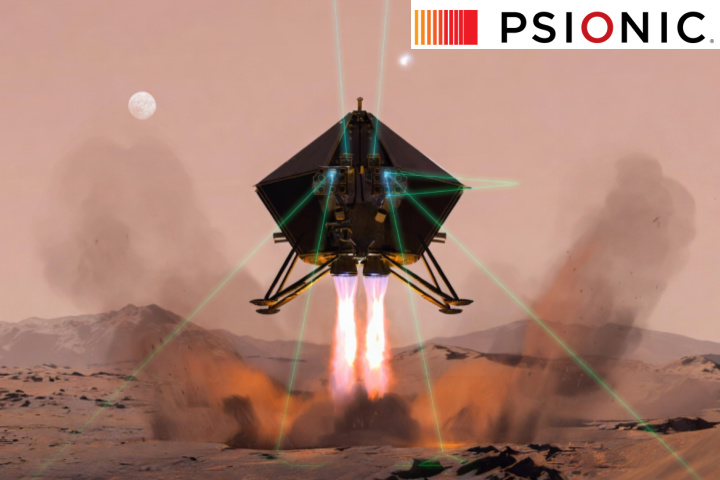
Psionic’s core Navigation Doppler Lidar technology provides ultra-precise velocity and range measurements that enable reliable navigation in GPS-denied environments, exactly the conditions spacecraft will face during lunar descent and landing or operations on Mars. As part of this new effort, Psionic will demonstrate TERCOM (terrain contour matching), which compares real-time elevation data from the surface below against known terrain maps to refine and constrain the navigation solution.
“It uses the terrain below,” explained Rob Fleishauer, Senior Vice President of Operations and Engineering at Psionic. “And of course, there are terrain maps for the lunar surface as well. So it helps us to land on the moon and in those areas as we’re coming through, navigating and coming into our landing cycle.”
“This is really a similar opportunity where we will fly again,” Fleishauer added. “And this time we want to demonstrate TERCOM, using terrain matching and contours to help constrain our navigation solution.”
The technology’s NASA heritage gives the agency strong confidence in its performance. Fleishauer, who previously worked as a NASA contractor, noted: “They’re very interested in our technology. Obviously, it was developed, the research and development was done at NASA, so they know it’s tried and tested, and it’s highly accurate.”
Psionic is evolving its Navigation Doppler Lidar from a single high-performance sensor into a full navigation suite, delivering the resilient, assured positioning, navigation, and timing (PNT) capabilities essential for autonomous landers, rovers, and future crewed missions.
This latest NASA collaboration follows Psionic’s recognition as the 2025 757 TechNite Emerging Company winner, another strong signal of its momentum and the depth of innovation happening across Hampton Roads.
For REaKTOR and the entire Hampton Roads region, Psionic’s selection is a powerful reminder of what our ecosystem can achieve. From its home base at REaKTOR, Psionic is turning NASA-born research into flight-proven systems that will help humanity land safely on the Moon and explore Mars. Companies like Psionic, deeply rooted in aerospace heritage yet pushing the boundaries of deep-tech commercialization — show that world-class space innovation is thriving right here in the 757.
We are incredibly proud to support Psionic as they continue advancing technologies that will shape the next era of human space exploration. Their progress strengthens our region’s role as a hub for resilient navigation, autonomous systems, and space technology.Learn more about Psionic and their groundbreaking work at psionicnav.com.
Stay tuned as REaKTOR continues to champion the innovators building the future from Hampton Roads.